|
|
|
Upper Meherabad, circa January 1937
taken by Elizabeth
|
|
Mehera: Baba's Hands
It was that time, when? When we were in Meherabad, I told you all, when we first came to stay with Baba - my mother [Daulatmai], myself, and Baba's old aunt [Dowla Masi] – we three women. So in the evening, we knew Baba loved music. In the evening, Baba would be singing. So in the evening [we said to each other], “We must go to Baba. We must have his company at least once in a day.” Be in his company, I mean.
So we all three would come over from there [the Bathroom Building] walking. We came to the Post Office. Yes, sure enough, Baba was singing. Baba was never playing [musical] instruments; he just played the drum to keep time. He could play that very well. But Adi [Sr] would be playing the sitar. And so Adi played the sitar, Baba sang so beautifully. His voice was most beautiful. And his voice was very beautiful, singing on the sitar. He never liked the harmonium, to sing [accompanied by] a harmonium, always the sitar.
So we went. I of course was very shy and all that. We came and sat far away. Baba's old aunt, my mother and myself, we sat there. All the mandali, the men and women separately. Baba was singing and playing; he took high notes so beautifully. I was watching. I looked down, like that. When the chorus part came, you know – not singing high – now the chorus is low in singing - at that moment, Baba stopped playing the drum and stopped singing. And he turned round to me and said, “What are you thinking?”
That time Baba was talking; he was not on silence. 1923. Baba said, “What are you thinking of?” At least, I think it was 1923, because in 1924 we came to stay with Baba. [It was 1924.]
Baba said, “What are you thinking of.”
I got so startled. My, I never knew Baba had this habit of asking what you are thinking of. I got a bit [nervous]. It was good I was thinking of Baba. I was not looking around or anything. I was looking at Baba - his fingers, his hands looked so lovely playing the drum. So I sort of liked to see his fingers, admiring them.
So Baba asked me “What were you thinking of?”
I said, "Baba, I am looking at your hands, your lovely hands. I am looking at them.” Just that much I said. I felt very shy with all the men sitting around and here I said [like this].
Sometimes, Baba made us feel awkward. In our minds, things come - but to say it is rather awkward. Anyway, but this was okay.
So Baba looked at his hands, like this [looking down at them]. Baba said, “You like my hands?”
Then more shy, I became. I said, "Yes, Baba." I don’t know if I blushed or I don’t know what I did. Anyway, I was very shy at that time.
Anyway what happened was this. Then we went with Baba to Quetta. That is a different story.
-- recorded by David Fenster on Saturday morning, 5 February 1977, Meherazad verandah
Return to Audio/ Video
|
|
|
|
|
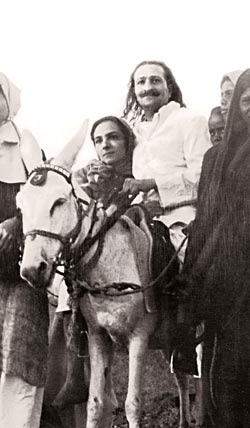
Mehera and Baba
Meherabad Hill, 1936
Mani - MSI collection
|
|
Mehera: Gulmarg
We were there four days maybe. That detail I don't remember. But Baba said that now that we are here in Kashmir, we must go out sightseeing, and all that. So we had to go to Gulmarg. Gool means flower; marg means pathway. "Pathway of flowers." It's a name; it's a very pretty Urdu name - Gulmarg. So, oh, we were so excited going to Gulmarg, but we did not know how we were going to reach Gulmarg. So we were in the car and we went very far away. I don't know how many miles drive it was. Anyway, [a long distance] outside this town, outside here, there we were, between pine forests, here, there.
Then the car came in, there was an opening. And there was a paddock and there were horses inside there. But they were horses that are mountain horses, you know, not those grand riding horses. Not grand riding horses; short ones. That high, and then some are higher, because there are men also who maybe want to ride. There are nice tall horses, also. But they are trained to be in the mountains. Strong kind of horses.
So Baba told us to get down from the car and, "Go and see which horse you want to ride." So, yes, we have to go on horseback on that path; the motorcar can't go. It was a pathway, it was not narrow, but a good car. But it was not allowed; cars were not allowed. (Now it seems that it is allowed for certain, some distance. It is allowed.)
So, anyway, I chose the best, nice, tall horse. And Baba chose the shortest horse. Baba was so sweet, yes, he is always sweet. Because Baba didn't care to be on a tall horse. A nice, short horse, means just his legs were above the ground. That was okay [for him]. And so he and Chanji was there. That is the first time, also, that Chanji was with us. (I don't know about Kaka [Baria], where was he. Kaka was there or not, I forget now. Kaka was there, but he was not riding, he was walking or riding?) The detail I don't remember, because they were at the back. So all the time, if I turned round back, Baba wouldn't like that. So once only I did to see Baba was on horseback.
So I turned around to see Baba was coming on horseback. Yes, we were in the front. Girls were in the front with the people who look after the horses, the gorewalas [grooms] we call them. When we trotted our horses, they had to run also [next to us]. But we couldn't gallop, because those people, they can't gallop! Men can't. So we just trotted a little and walked. Most of the time we walked [the horses], and so on. Baba, Chanji and Kaka, I think was there, and they came. Anyway, once or twice I looked. Baba looked so sweet on the horse. Baba coming slowly, slowly. Very sweet. And so then ...
David: Was his hair open?
No, that time I don't think so. 1944 [it was 1943], Baba used to have his hair tied. But, I'll tell you this ...
When we ... It's a long ride; it's a nice long ride. It's a very lovely pathway-made dirt road, tidy. Go up, and up, and up, and up; then go a little bit down, down, then up, up, I don't know. Then you turn, there's a turn round the mountain. And then you see it was an open space like a beautiful valley, but it is, what would you call it, well kept, would you say that? Pathways made. There's a library; I don't think there was a school. A library and some kind of club, or something. There were cottages of European people, separate, far away with their own garden with a lovely hedge-boundary. Very, very pretty it was. Very pretty. And then this side, far away - not very far away, but you could see very clearly - a green, green golf course. And Westerners were playing golf. And here we were nicely riding. Many people come riding, but at that time it was good we were alone there.
Anyway, we went and then we have to go through this place, this nice place. And then we go a bit further away. There was also another Western, European person's house and garden. There was this opening ended, because there the thick, thick forest of pines and all that, the mountains started again. This was like a flat, big space, you know, between the mountains. They had made it that way for people to come and be there, rest there. Maybe there must have been a hotel or something there, also. That detail I don't know. (David: Resort.) A resort, that's it. You can spend a few days there.
Anyway, up on the top of another mountain, and then the scenery changed. It was flat, beautiful, what would you call it, plateau. Lovely plateau with a lawn; as if someone had made a tidy lawn ... big, big plateau. And there must have been a hut, I don't know whose hut there was. But a hut means a little room or two, far away. A very primitive kind of thing.
But there were one or two ponies grazing. And the mountains behind. Behind this green plateau, the Himalayas had started now. So you could see maybe the highest peak or not, I don't know ... I don't know what [the peak] is called. Perpetual snow you can see from there. It was crisp and cold. Being summertime, [still] it was crisp and cold; blue sky and very lovely. There was no breeze. Crisp and cold; and blue sky; and the green [lawn]. And Baba loved it. Baba had a good walk here and there. Baba said, "Look there, see the snow ... It's perpetual snow," like that. You know how he used to talk. And we all went round here and there.
And then we sat down. I don't know what we sat down on. Did we bring something, sandwiches with us? I forget that. Little packages of them. Maybe we did, and we were seated on the grass and we were having a bite or something. And by that time, then this plateau ... These coolies they bring down ice for the town that was nearby ...
It was very lovely up there, very beautiful. And then again we walked down. And when we walked down, then we walked around a bit here and there, saw the library was there. Some people were gathered there; who they were we don't know. Anyway, there were some here, some there, in groups and all. And again some people playing on the golf course. It was, I mean, not much inhabited, but guests, you know, tourists come. They were like that.
Then we were told to get on our horses and we have to go home now. So we said, "Oh, fine." We were very glad to get on them. We got on our horses now. And when this place, you know, where this place was, you know [David: The flat area]. Yes, there is a library on this flat area, that space you walk through the place, and you are on the horse. So when we walked, then we came back like this. And then there was an incline. So I knew: A horse cannot run away with you on an incline. Because it is facing home, a horse always gets very excited. Going home, you must not urge a horse to run. It is a real [true] thing that you must remember.
But I wanted the horse to have a nice gallop. I said, "Now we are going home, at least I should enjoy the ride." Baba was a bit far behind and Baba did not mind ... So I wanted to have a gallop. So Mani and Meheru, they did not know. I started riding. I urged the horse with my heels, and he was too happy to go towards home. He galloped so fast, but it was an incline; still he was galloping, galloping, galloping. Oh, I had fun, you know.
When we got off the hill, not the hill; it was a smooth lovely, this dirt road, clean and very broad and nice. When it got on the top, he [the horse] was nicely tired. So I was glad that he was tired so he couldn't run away with me. Anyway, I was far from the others. Then, yes, then I saw Baba was far behind, and the girls [were calling], "Arey, Mehera, Mehera, stop, Mehera!"
So I said, "No, let me finish this gallop."
David: Did they have regular saddles?
They had regular saddles. They saddle it for you at that paddock, you know.
David: You didn't ride English style did you?
[No, always astride.] This way [English style] is not nice. It's all right for the [British] Queen to do it, because she has to ... But what I want to say ... Anyway, we got home at last and got down. Mani and Meheru said, "My ... (because we are not used to it), all our muscles in our legs are like this [sore]. We can't walk now." But it was good our car was nearby. Anyway, we limped to our car.
David: Did Baba come?
Baba came on his small horse, very slowly, slowly. We waited for Baba. Chanji, Baba, and Kaka. (I think Kaka was there also. Yes.)
And so, he got down from the horse. Baba said, "You liked it? Enjoyed it?"
I said, "Yes, Baba, it was lovely. I had a nice ride, also."
Baba said, "Good. I am happy." So Baba said, "Now all get in the car." So we all got in the car and came home.
That was Gulmarg. Very beautiful place.
-- recorded by David Fenster on Saturday morning, 3 September 1977, Meherazad verandah
Return to Audio/ Video
|
|
|
|
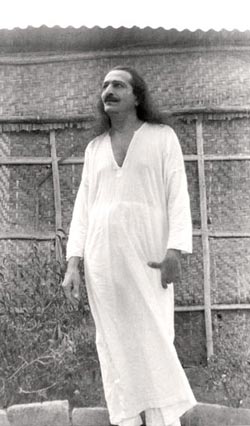
Meher Baba
Upper Meherabad, 1934-35
Mani - MSI collection
|
|
Mehera: Baba Loves You
Baba is the Avatar. Like Jesus Christ. Baba is the Avatar. And he suffered for us. You must know that. How many years of silence [he kept]. He loved singing, he had a beautiful voice for singing, but he gave up his singing - sacrificed his love for talking and singing – all for us, because he loved us so much. He went through so much suffering: two motorcar accidents and other suffering. Much. That’s why always, when I speak to Baba's photo, I tell Baba that "Only you know how much you suffered.” Even we cannot know, though we lived with you.
So what I want to tell you is that you are very fortunate to love him. Now it is time for us to love him. He loved us; now we must love him. Yes?
Because he is God-realized. Others you may see they just talk. They will give good talks and they gather people around them. But they are not God-realized. They have a clever way of talking. They read Baba's books, and they give the knowledge as if they know it. You see what I want to say? There will be many such [persons].
But don’t go on the crooked path. [Keep on] the straight to God, to Baba. Keep your path straight to Baba. There will be attractions this way and that way, but don’t be attracted. Remember this: Once you love Baba, keep loving him. Yes?
And Baba said, “I will never fail my lovers.” So someway or another he will help you …
He is here as well as everywhere, he is. Baba said, “I am with all my lovers.” Baba had said that. And once Baba said that “I will never fail my lovers.” This is what Baba said. So you all are very fortunate to love him.…
He is so compassionate, because we, in our work, and what would you call it? When you are engrossed in something, you are not thinking of Baba. But that moment, also, Baba is thinking of you. He never forgets you. We may [forget him] – but he doesn’t. His grace is so … his eyes are on all his lovers. You know? He keeps an eye. Yes?
The only thing is that we can't see him [now]. He can see us. That is the only thing now. So how happy you make him with your love. It is time for us to love him. He has loved us so dearly. So beautiful his love was. All these years he suffered for us. So …
Yes, Baba said many times this happens [reincarnation in a different sex]. But with me, I feel and know and if, next time I will be born, I will be born as a woman. But Mani and everyone tells me that “Baba won’t let you be born again.” This is what someone tells me. I said, “No, I want to come again with Baba.” When Baba takes physical form, [He will bring you] I would like to come and serve him, obey him and make him happy. See his beautiful eyes shining with pleasure and happiness. You know. It is so beautiful. To see his pictures is different; but to see him alive is very beautiful."
Baba had very fair skin, not very white, but fair skin … Baba was very fair and very lovely Baba was …
Baba said, “My love brings you to me.” So that shows Baba loves you. It is wonderful to be loved by the God-Man. Yes? Always know that. Be happy in his love. He is with you wherever you are. Say his name and he is very near you. Helping you always. Jai Baba.
-- recorded by David Fenster on Meherazad verandah on 25 June 1978 and 8-9 October 1977
Return to Audio/ Video
|